

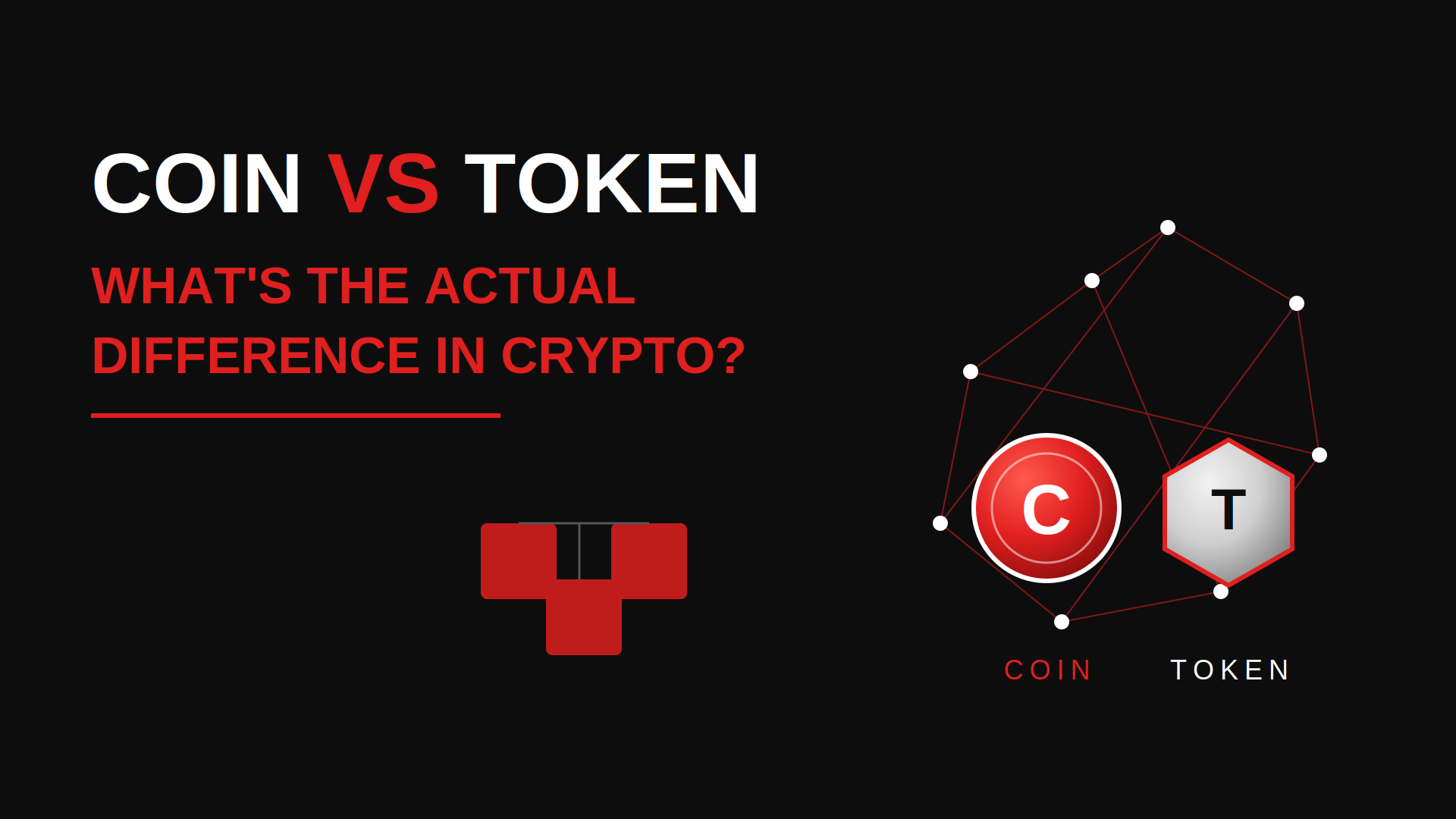
Coin vs Token: What’s the Actual Difference in Crypto?

If you are a beginner in cryptocurrencies, then you must have observed that some cryptocurrencies are referred to as coins and others as tokens. There may be similarities in their usage; however, they represent different elements altogether.
Here is the easiest way to distinguish between a coin and a token:
A coin has its blockchain. A token works on an existing blockchain.
Bitcoin is a coin because it is based on the blockchain of Bitcoin. ETH is a coin because it runs on the blockchain of Ethereum. But USDC is a token because it works on already existing blockchains like that of Ethereum and Solana, among others.
This knowledge helps one understand crypto networks, applications, and cryptocurrencies better.
What Is a Crypto Coin?
A cryptocurrency coin is a digital asset that operates on its own blockchain.
The blockchain provides the infrastructure for recording transactions, maintaining balances, and securing the network.
Some well-known examples include:
- Bitcoin (BTC) on Bitcoin
- Ether (ETH) on Ethereum
- Litecoin (LTC) on Litecoin
- Solana (SOL) on Solana
Coins are generally associated with the operation of their native blockchain.
For example, ETH is used to pay transaction fees on Ethereum. BTC is used to pay fees on the Bitcoin network.
This means coins often have a direct relationship with the blockchain’s infrastructure.
What Is a Crypto Token?
The token does not always have to be backed by its own blockchain. Instead, a token is built and managed through the help of an existing blockchain system.
For instance, tokens can be built using smart contracts in the Ethereum blockchain. They can represent different items such as digital currency, voting power, asset, or access to an app.
Examples of tokens include: USDC, UNI, LINK, AAVE.
They operate on blockchain technology without creating their own separate blockchain system.
Thus, a token can be created without creating a completely new blockchain.
The Biggest Difference: Their Blockchain
The easiest way to remember the difference is to ask:
Does the asset have its own blockchain?
If yes, it is generally considered a coin.
If it exists on another blockchain through a smart contract or token standard, it is generally considered a token.
For example, ETH belongs to Ethereum’s native blockchain. USDC can exist as a token on Ethereum and several other networks.
This distinction is more important than simply looking at the asset’s name or market value.
How Are Coins Used?
Coins can have several functions depending on their blockchain.
One major purpose is paying network transaction fees.
For example, users need ETH to pay gas fees for transactions on Ethereum. Similarly, users need BTC to pay Bitcoin network transaction fees.
Coins can also be used for:
- Transferring value
- Staking
- Network participation
- Paying for blockchain services
- Acting as a native asset within decentralized applications
The exact role depends on how the blockchain is designed.
How Are Tokens Used?
Tokens can have much broader use cases because developers can program their functionality through smart contracts.
A token might represent:
- A cryptocurrency
- Governance rights
- Access to a service
- A real-world asset
- A digital collectible
- Rewards
- Voting rights
For example, a governance token can give holders the ability to participate in decisions within a decentralized protocol.
Stablecoins are another common example. A token such as USDC is designed to maintain a value linked to a reference asset, rather than functioning as the native currency of the blockchain itself.
Coins and Tokens Can Both Be Used for Payments
This differentiation doesn’t imply that the coins are utilized in transactions whereas the tokens aren’t used.
Both can be utilized for transferring values.
The key point here is that of the place where the asset resides and the way it works.
The token can act as a means of payment, whereas a coin may serve some additional purposes other than payments. Thus, the use case is not a determinant of either.
How Are Tokens Created?
Token creation can prove to be a relatively simple process compared to the creation of a blockchain.
Developers, on an Ethereum-based network, can use well-known token standards like ERC-20 for creating fungible tokens.
The need for creating an entire consensus mechanism, networking system, and the infrastructure of the blockchain does not arise.
In this way, the technicalities involved in creating a cryptocurrency become simple.
But compared to creating a successful project around it, token creation is a relatively simple process.
Can a Token Become a Coin?
Yes, but it depends on how the project will evolve.
First, a project can launch its token on some other blockchain just for awareness purposes, rewarding and building an ecosystem around it. Later, a project can have its own blockchain developed and the asset can be moved to that blockchain.
In case the asset becomes a native asset of its own blockchain, then it can be called a coin.
This is known as a mainnet launch or migration process.
But not all token projects need their own blockchain.
What About Wrapped Tokens?
Wrapped assets may also contribute to confusion in this regard.
Wrapped tokens are usually representations of some other asset that resides on another blockchain.
So, there is also the possibility of having a representation of BTC on another blockchain in the form of some other token.
It does not mean that the token has turned into Bitcoin’s native coin.
Why Does the Difference Matter?
Having knowledge about coins and tokens will help you to understand the structure of crypto ecosystems.
When doing your research about some project, it can tell you something about technical architecture of the project whether the asset belongs to its own blockchain or was issued on some other one.
In particular, it will be helpful for understanding the following things:
- Transaction fees
- Wallet compatibility
- Network selection
- Interaction with smart contracts
- Token transfers
- Staking
For instance, transferring the token to the wrong blockchain/network may cause major troubles if the receiver’s wallet or platform cannot support the network.
Coin vs Token: A Simple Comparison
The difference between crypto coin and token lies in ownership and use of blockchain infrastructure.
A coin is the digital currency native to its own blockchain network. A token is generated on top of a pre-existing blockchain infrastructure and runs on top of that blockchain’s infrastructure.
Coins are usually tightly related to fees, security and blockchains’ operations, while tokens may be used for a variety of functions in the ecosystem of decentralized apps.
After you get acquainted with the concept, such definitions as native asset, ERC-20 token, stablecoin, governance token and wrapped token will become clearer.
FAQs
Is Bitcoin a coin or token?
Bitcoin is a coin because BTC is the native cryptocurrency of the Bitcoin blockchain.
Is USDC a coin or token?
USDC is typically referred to as a token since it is built on top of already existing blockchain networks and not the native cryptocurrency of its blockchain.
Is ETH a coin or token?
ETH is a coin since ETH is the native cryptocurrency of the Ethereum blockchain. It is used for making payments and other transactions in the Ethereum blockchain.
Can one token be found in more than one blockchain?
Yes, there are some tokens that can be found on different blockchain networks. But they exist on different networks, so users need to make sure which network they are transferring their coins to.